The agreement emboldens the Zionists
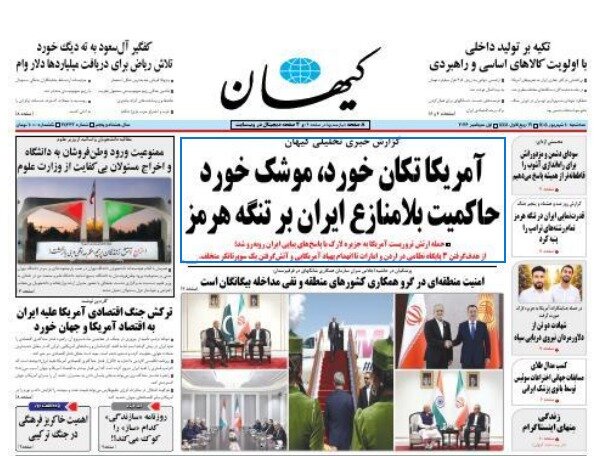
Kayhan, in an article, criticized the reformist camp’s view of the Islamabad memorandum. The paper wrote: Reformist claimants portray a return to the memorandum as a guarantee of peace, yet an Israeli minister has threatened Iran, saying that an agreement with the United States will not restrain Israel’s determination.
Kayhan, in an article, criticized the reformist camp’s view of the Islamabad memorandum. The paper wrote: Reformist claimants portray a return to the memorandum as a guarantee of peace, yet an Israeli minister has threatened Iran, saying that an agreement with the United States will not restrain Israel’s determination. It appears that returning to the memorandum is a mirage of “peace and ceasefire”; just as Trump’s signature did not guarantee Israel’s conduct in Lebanon, there is likewise no assurance against renewed Israeli adventurism. By violating the first clause of the Islamabad memorandum, Israel demonstrated that it follows a path independent of Trump, and that the United States cannot guarantee Israeli behavior nor restrain its brutality. Considering Israel’s repeated violations of Clause One, the reformists’ insistence on returning to the memorandum sends a signal of weakness. Thus, returning to the memorandum feeds the Zionists’ illusion of superiority and drives Netanyahu into a state of ferocity.
Khorasan: CENTCOM and the military deadlock
Khorasan analyzed recent strategic shifts in US military behavior and wrote: One of the strategic changes in recent months is the altered conduct of American forces. Previously, maritime confrontations were met with retaliatory US strikes along Iran’s coasts (islands and installations). But why is it that now — despite continued IRGC Navy missile and drone attacks on violating vessels — there is no sign of US missile responses against the shoreline? This silence stems less from restraint and more from a strategic assessment by CENTCOM. They have concluded that geography rules the southern Iranian theater, and Iran’s dominance over this expanse exceeds America’s capacity for direct military confrontation. As American strategists themselves put it, “You cannot wage war against geography.” This shift in the balance of power has pushed the US to relocate the conflict to the realm of narratives, because on the battlefield — at least under current conditions — they have no achievements to showcase.
Sazandegi: Breaking the Iran–US negotiation deadlock through mediators
Sazandegi, in an article, examined the visit of Sheikh Mohammed bin Abdulrahman Al‑Thani, Qatar’s prime minister and foreign minister, to Tehran. According to the paper, the Strait of Hormuz has once again become the epicenter of the Middle East crisis, and Qatar is attempting to play a role beyond that of a worried neighbor. The visit occurred at a time when Iran–US negotiations had reached a deadlock, regional military tensions were rising, and the future of freedom of navigation in one of the world’s most important waterways had become uncertain. Qatar and other mediating countries now find themselves in a position where the success or failure of their mission could shape subsequent developments. Mediators must, on one hand, address regional security concerns and the issue of free navigation in Hormuz, and on the other, accommodate Tehran’s firm positions regarding sovereignty, security, and US behavior. Ultimately, reviving and revising the Islamabad memorandum could become a starting point for breaking the deadlock.
Resalat: The myth of US hegemony faces an identity crisis
Now, six months after the start of a full‑scale conflict that was supposed to be a mere display of America’s uncontested power and unstoppable war machine, the world is witnessing a profound paradigm shift in global power dynamics. Beyond domestic consequences, the tremors of this conflict are reshaping the global geopolitical map. Reduced focus, depleted weapons stockpiles, and the exposure of US limitations in the Middle East have sent emboldening signals to Moscow and Beijing. Traditional US allies — from Europe to the Persian Gulf — look anxiously at skies no longer covered by Patriot defense umbrellas and are reassessing strategic alliances, moving toward new balances of power. This is no longer merely a war over nuclear weapons or regime change; it is a turning point in which the myth of America’s absolute and uncontested hegemony in the Middle East is facing an identity crisis.
Ham‑Mihan: China, a powerful ally
Ham‑Mihan, in an analysis, discussed the expansion of Iran–China relations and wrote: The future of our region depends on developing strong and mutually beneficial relations with China. For years, Iranian public opinion was exposed to waves of Western media propaganda portraying China as a threat. Fear‑mongering about China’s intentions, goals, and policies was constant. This perception is now changing rapidly. A growing number of Iranians recognize China’s constructive role. There is also a rising understanding that Iran and China are both ancient civilizations with millennia of history, shared traditions of trade, cultural exchange, and centuries of interaction. Many Iranians now view this historical heritage as an opportunity to build stronger relations with China across all dimensions. From this perspective, perhaps Trump — more than anyone else — accelerated this shift in attitudes. In that sense, one might even thank him.
Leave a Comment